


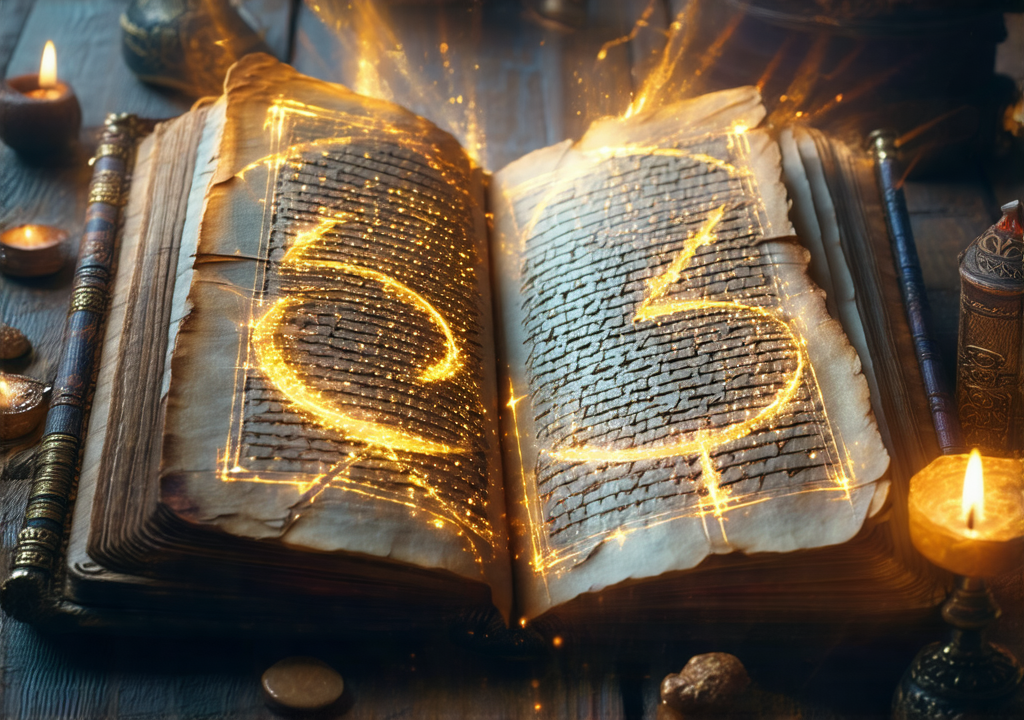
In 1904, Aleister Crowley received The Book of the Law (Liber Legis) through a divine dictation during his honeymoon in Cairo, Egypt. This short but dense work became the cornerstone of Thelema—the esoteric philosophy and mystical system that would reshape Western occultism for generations. At first glance, it appears deceptively simple: “Do what thou wilt shall be the whole of the law.” But beneath this deceptively straightforward statement lies a labyrinthine text rich with hidden meanings, subtle contradictions, and profound revelations that most readers overlook entirely.
Let us explore five secrets buried deep within Thelema’s sacred text.
1. The Triple Godhead: Nuit, Ra-Hoor-Khuit, and Hadit
While many Thelemians recognize Nuit (the starry goddess) as the primary deity of Liber Legis, few fully grasp the triadic structure that Crowley embedded throughout the text. Nuit represents infinite space and possibility; Hadid, her opposite pole, is the infinitesimal point—the innermost core of every being. Between them dances Ra-Hoor-Khuit, the manifested god in his crown and pillar configuration. This threefold division—Nuit as the Mother, Hadith as the Father, and Ra-Hoor-Khuit as the Son—is not merely theological ornamentation but a complete cosmological system that mirrors Hermetic principles. The secret lies in understanding that these are not separate gods but different aspects of one divine reality, much like the threefold nature of the sephiroth on Kabbalistic trees.
2. The Year Zero: When Thelema Began
Most readers miss the significance of “A.X.” and “I.X”—not merely Roman numerals marking Crowley’s birth year, but sacred numbers encoding esoteric meaning. “A.X.” stands for the age of Christ (or, as many scholars argue, the age of Horus), while “I.X.” marks its conclusion. Crowley declared that Thelema would reign from 1904 to approximately 2030, creating a precise chronological framework often overlooked in casual reading. Furthermore, the number 666—which appears repeatedly throughout Liber Legis—is not merely the Beast’s number but represents the divine man (Horus) incarnate. The triple six encodes the complete manifestation of divine will through human form.
3. The Hidden Doctrine: “Do What Thou Wilt” Reimagined
The famous aphorism has been misinterpreted countless times as mere license for selfishness or hedonism. Yet true understanding requires recognizing that “wilt” refers not to fleeting desires but to one’s ultimate purpose—the unique will inherent in each soul from birth. Crowley himself clarified this when he wrote: “The word ‘will’ is more exact than ‘desire’, and the phrase ‘do what thou wilt’ means ‘act according to thy nature.'” This transforms Thelema from a philosophy of indulgence into one of self-discovery, where each individual must discern their authentic purpose rather than following external moral codes.
4. The Secret Name: A.R.666
Within the text itself lies an encoded message about “the true name” that most readers miss entirely. When Liber Legis declares that every human being has a secret name hidden within them, it is not referring to baptismal names or even soul-names as commonly understood. Rather, this true name represents one’s unique vibration—the particular configuration of divine energy that distinguishes one individual from all others. The number 666 appearing repeatedly in the text hints at this principle: every person bears a name corresponding to their own specific manifestation of the Beast.
5. The Prophecy Within: What Crowley Knew But We Forget
Most readers treat Liber Legis as a static document but miss its prophetic dimension entirely. The book contains not only instructions but predictions—about future events, about humanity’s trajectory, and especially about the coming age of Horus that would follow the age of Christ. The secret prophecy within “The Book of the Law” is not merely temporal; it describes an ongoing transformation where every individual must discover their own truth rather than accepting inherited beliefs. This message resonates particularly strongly in our contemporary world, where people increasingly question traditional authority and seek personal revelation.
Beyond Understanding: The Living Text
What makes The Book of the Law so enduring is not merely its content but its structure as a living document that grows with each reader’s engagement. Crowley designed it to be experienced rather than merely read—each encounter yields new insights, much like a sacred text that reveals itself gradually over time.
The five secrets we have explored here represent only the surface of this vast wellspring. The true treasure lies not in memorizing passages or quoting aphorisms but in embodying their spirit: discovering one’s unique will and living it fully. As Crowley himself wrote, “Every man and every woman is a star.” Perhaps the greatest secret hidden within The Book of the Law is that we are meant to become our own masters—not following external authority blindly, but recognizing our inner divinity and acting accordingly.
In a world drowning in information yet starving for wisdom, Thelema offers not another set of rules but an invitation to self-discovery. And that, perhaps, is why The Book of the Law remains relevant today nearly a century after its revelation: it speaks directly to every person’s potential to discover their own truth and live it boldly in the world.


Recent Post


Gallery






Featured Videos







No Comments