


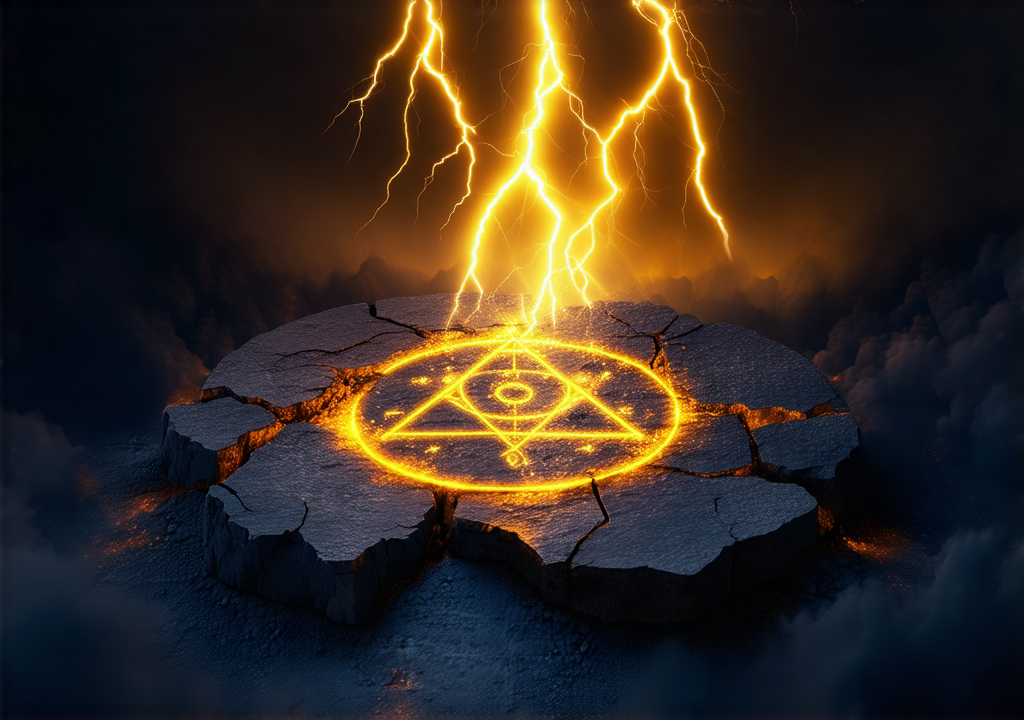
If you haven’t yet encountered Thelema, you’re about to discover an ancient-yet-revolutionary philosophy that has captivated the minds of occultists, writers, artists, and seekers for over a century — yet remains largely unknown outside esoteric circles.
What is Thelema?
The word Thelema comes from the Greek θέλημα (thélēma), meaning “will.” In its purest sense, it denotes that which is willed or intended — an inner impulse of the soul rather than mere desire or preference. While everyday desires are often shallow and fleeting (wanting ice cream for the sake of pleasure), true Will has been described as the unique destiny or purpose each individual carries within themselves from birth.
The philosophy was codified in 1904 by Aleister Crowley during what he called a revelatory experience in Cairo, Egypt. Crowley, an English occultist and ceremonial magician, claimed that a supernatural entity named Sphinx dictated to him a sacred text known as The Book of the Law, which contains the central tenets of Thelema.
The Central Tenet: “Do What Thou Wilt”
The most famous declaration in The Book of the Law reads simply: “Do what thou wilt shall be the whole of the law.” This often gets misunderstood as hedonistic license — a permission to do whatever one pleases whenever one pleases. But that interpretation misses the point entirely.
The “will” referenced here is not caprice but rather the authentic expression of one’s deepest nature. The phrase suggests that when you act in accordance with your true will, you naturally align yourself with cosmic law — and any action taken from this alignment carries its own integrity. Conversely, acting contrary to your will produces friction, dissatisfaction, and chaos.
Crowley also clarified this principle further: “Love is the law, love under will.” Love here means attraction — the force that brings things together toward fulfillment of their respective destinies. Love must be governed by will; otherwise it becomes sentimental or destructive.
Key Principles in Thelema
Beyond its central tenet, several other key ideas form the backbone of this philosophy:
- Every man and every woman is a star — Each individual is autonomous, radiant with their own light, and follows an independent course through life. No external authority can dictate another’s path.
- “Do what thou wilt” implies both freedom and responsibility — You are free to choose your path, but you bear full responsibility for acting on that choice.
- The Law of Thelema is not fatalism or determinism — While some may view it as predestination, Crowley described it as a dynamic process where one’s will unfolds progressively through experience.
Why Is It Controversial?
Thelema generates controversy on several fronts:
First, its central text The Book of the Law contains passages that seem cryptic, contradictory, and occasionally shocking even to committed practitioners. Crowley himself acknowledged this — he called it “an enigma” rather than a straightforward gospel.
Second, the philosophy’s emphasis on individual sovereignty can appear individualistic to the point of narcissism or libertarian to the point of ego-tyranny. The phrase “Do what thou wilt” has been mocked as promoting selfishness above all else.
Third, Crowley’s own life — marked by excesses in drinking, smoking, and sexual experimentation — made him a target for critics who saw his philosophy as justification for hedonism rather than spiritual discipline.
Yet this controversy is precisely the point: Thelema demands honest self-examination. It asks each person to discover their own truth rather than accept inherited beliefs or social conventions at face value. That requirement makes it both liberating and demanding.
How Has Thelema Been Practiced?
Over the past century, followers of Crowley have developed various practices to align themselves with their will:
- Magick (Crowley’s spelling) — defined as “the science and art of causing changes in conformity with the Will”
- Yoga, meditation, and ritual practices adapted from both Western esoteric traditions and Eastern disciplines
- Reading and writing Crowley’s extensive corpus of books, letters, and poetry
- Community life through organizations such as Ordo Templi Orientis (OTO)
Some notable figures influenced by Thelema include writer L. Ron Hubbard (founder of Scientology), poet Jack Kerouac, musician Bob Dylan, filmmaker Alejandro Jodorowsky, and many modern occultists who continue to write, translate, and teach Crowley’s works.
Why Thelema Matters Now
In an age characterized by information overload, social pressure, and endless options, the question “What do you want?” becomes almost paralyzing. Thelema offers a different approach: rather than choosing from external standards or following popular trends, seek within until your own will reveals itself. Then act on it.
The philosophy speaks particularly well to people who sense that something is missing in conventional religion — too much dogma, too little personal experience; too many rules, too little freedom. It doesn’t demand belief in any particular deity (though Crowley’s texts are filled with deities like Nuit, Hadit, and Ra-Hoor-Khuit), but rather invites direct encounter with the divine through one’s own will.
Conclusion
Thelema remains controversial because it refuses to provide easy answers. It asks each person to become both philosopher and experiment in their own life — to read their own nature as a sacred text and to live accordingly. Whether you adopt its practices or simply borrow from them, Thelema offers something worth knowing: that your deepest self knows what you ought to do if only you would listen.


Recent Post


Gallery






Featured Videos







No Comments