


By The Qabalist of Saint Cyprian’s Gate
I am writing this to you, seeker, from within the very heart of that ancient and misunderstood tradition known as the heretical school of Qabalah. Before I begin my exposition, let me make something perfectly clear: I have spent years in modern psychology — not merely as a casual enthusiast, but as one who has devoured its literature with scholarly precision, attended its conferences, undergone its analysis, and attempted to follow its prescriptions. And still, for all its sophistication, for all its statistical significance and peer-reviewed publications, I found it wanting. So I turned away from modern psychology entirely — and toward the heretical Qabalah that had been waiting beneath the surface of my own soul since childhood.
In this essay, I will explain why I quit modern psychology, what the heretical Qabalah offered me in exchange, and why I am not going back to the comfortable institutions that once employed me.
The Problem with Modern Psychology
Modern psychology is built upon a foundation of reductionism. It takes the rich complexity of human experience — our dreams, our suffering, our longing for meaning — and breaks it down into neat categories: depression here, anxiety there, personality traits measured on Likert scales from one to five. And while this approach has its merits, something essential is lost in translation.
The heresy begins precisely where modern psychology ends: at the boundary of measurement itself.
When you reduce love to a neurochemical transaction — dopamine, serotonin, oxytocin — do you capture what makes love meaningful? When you classify trauma according to DSM criteria, do you honor its transformatory power? Modern psychology seeks to normalize us, to fit us into diagnostic boxes, to medicate our discomfort until it becomes manageable. But heretical Qabalah asks something different: What is your suffering trying to teach you?
The difference between these two approaches is not merely methodological — it is cosmological. It concerns the very structure of reality itself.
What Is Heretical Qabalah?
For those unfamiliar with this tradition, let me explain briefly what I mean by “heretical Qabalah.” The word Qabalah (sometimes spelled Kaballah) refers to an esoteric mystical tradition originating in ancient Jewish thought and later adopted into Christian hermetic circles. It is not merely a set of beliefs but a system of correspondences — a language for reading the universe as if it were written in code.
The heretical branch includes practitioners who have rejected the authority of established religious institutions while retaining the sacred structure of Qabalah’s teachings. They are the outsiders, the mystics who dared to question whether their teachers’ teachers had got things right. And they have done well — remarkably so — because heresy is often just truth that has not yet been canonized.
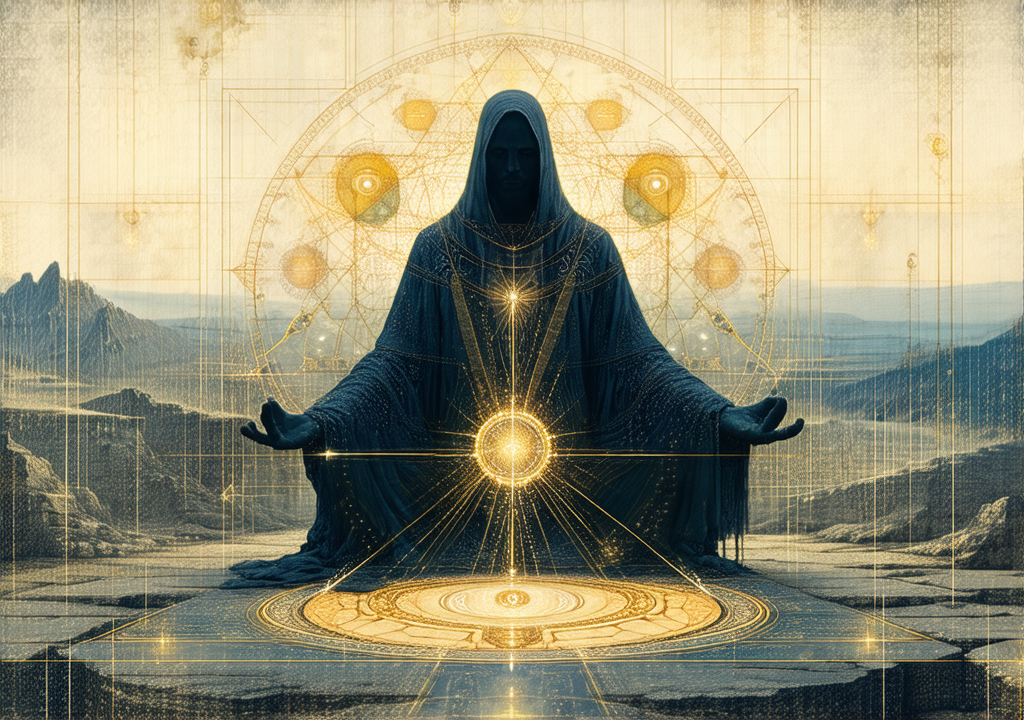
The central symbol of Qabalah is the Tree of Life — ten spheres (sephiroth) connected by twenty-two paths, representing the structure of both cosmos and consciousness. To navigate this tree is to practice a kind of mystical geometry in which mathematics meets meaning, where numbers become living entities and letters become vessels for divine forces.
Why I Left Psychology Behind
I left modern psychology because it offered me symptoms without salvation. It gave me labels but not liberation. It taught me about my childhood without teaching me about my soul.
What I wanted — what I have always wanted, perhaps since before I had words — was transformation. Not merely improvement or adjustment, but genuine metamorphosis: becoming who I might become if the veils of illusion were removed and I stood naked in my own essence.
Modern psychology assumes that beneath our symptoms lies a healthy self waiting to be discovered. Qabalah assumes something more radical: that our symptoms are messages, encoded in language we have forgotten how to read. The anxiety that troubles us is not merely a malfunction — it is a signal from the deeper parts of ourselves, speaking through the medium of suffering.
The Practice I Found
For those who wish to know what heretical Qabalah actually looks like as practice: begin with meditation on the sephiroth. Each sphere represents an aspect of divine emanation — Keter (the Crown), Chokhmah (Wisdom), Binah (Understanding), and so forth through Chesed, Gevurah, Tiferet, Netzach, Hod, Yesod, Malkuth.
I began with a simple practice: choosing one sephirah per week, contemplating its meaning, and recording my experiences. Then I moved to more complex practices — the use of Hebrew letters as meditational keys, the application of gematria (numerological calculation) to names and texts, the drawing of sigils and invocation of divine names.
What struck me was how immediately these ancient tools felt relevant — not as historical curiosities, but as living instruments for navigating consciousness itself. When I meditated on Tiferet (Beauty), I found myself experiencing a sense of harmony that no medication had ever provided. When I applied gematria to my own name, I discovered patterns in its numerical value that mirrored events in my life with uncanny precision.
A Note on Heresy
The heretical tradition is not merely about rejecting authority — it is about reclaiming what authority has suppressed. The early Christian heretics (the Gnostics, the Arians, the Docetians) preserved knowledge that would have been lost otherwise. And so too does modern Qabalah preserve knowledge that psychology has overlooked: the reality of the astral plane; the existence of spiritual entities; the efficacy of sigils and invocations as genuine psychological forces operating at levels beyond conventional analysis.
To be heretical is not to be wrong — it is to have encountered truths whose names in official circles are still unpronounced.
Why I Am Not Going Back
I am writing this from within my own practice, after years of continued exploration and deepening understanding. The reasons for staying are many: the richness of the tradition; the depth of its symbols; the fact that it offers not merely a theory but a practice; the feeling — which I have experienced repeatedly over these past months — that something real is happening when I practice, something genuine beyond the merely subjective.
Modern psychology offered me improvement. Qabalah has offered me awakening. And so far as I am concerned, those are two different orders of transformation entirely.
If this resonates with you, know that it was written for you — and that my door is open to all who wish to explore the heretical path together.















No Comments