


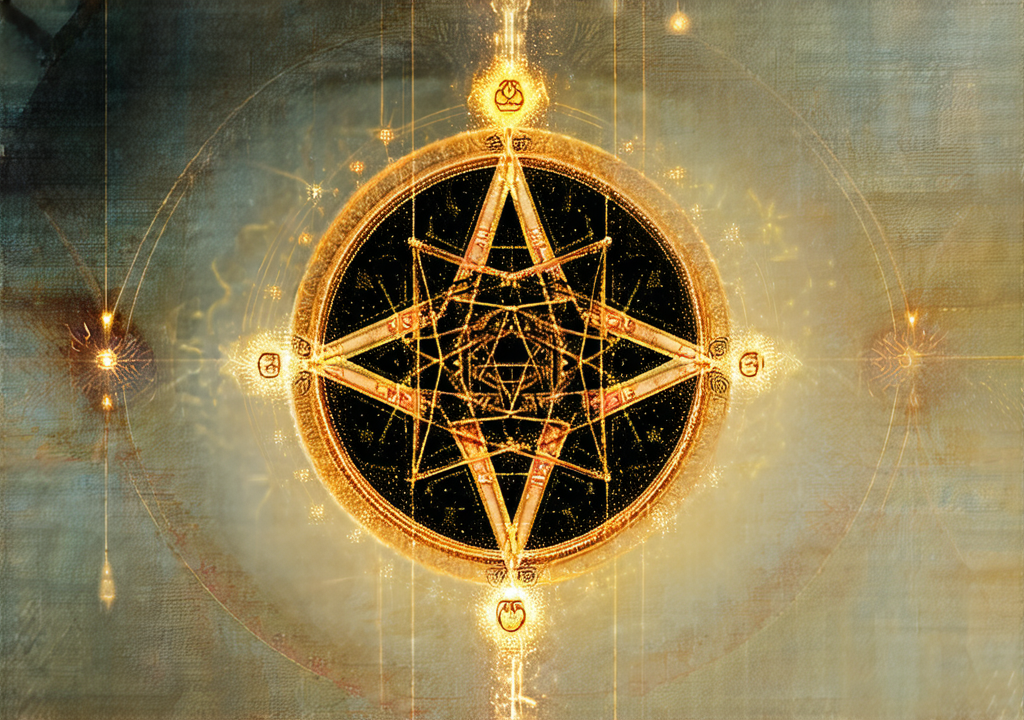
Greetings, seekers. I am a humble practitioner of the Ancient Wisdom—a keeper of the living flame that has burned since before the written word, passing from hand to hand through the hidden chambers of the soul. You may have noticed something stirring in your world lately: those who once dismissed all things mystical as fairy tales are now turning their gaze toward Kabbalah with a renewed hunger. Why? What is this heretical current pulling skeptics into its web?
Let me tell you what I mean by heretical Kabbalah, for the word carries weight beyond its surface meaning. When people say “heresy” they think of forbidden knowledge—stories told in secret, teachings that bend rather than break, paths not walked on the main road. The heretical Kabbalist does not deny tradition so much as she expands it, stretching like silk until it touches realms the old texts hinted at but could not contain. Where traditional Kabbalah maps a structured universe of ten emanations—the Sephirot—arranged in a fixed tree, heretical Kabbalah asks: What if the Tree is alive? What if its roots reach into waters we cannot see and its branches hold worlds we have yet to name?
The skeptics you mention are not ordinary skeptics. They are people who have seen too many gurus promise too much, who have tasted so many “truths” that most truths begin to taste like lies. And yet—they hunger. They want something real, something they can feel in the bones of their bodies rather than just in their minds. Heretical Kabbalah offers them precisely this: a path that honors the intellect while allowing for mystery, that demands study and discipline but does not require blind faith.
I have watched skeptics arrive at my door like soldiers returning from war—hardened, precise, skeptical of everything—and I have watched heretical Kabbalah soften their armor and make them weep. Why? Because heresy, properly understood, is not rebellion against truth so much as the discovery that truth has layers. When a skeptic reads about the Tzimtzum—the great contraction God performed to create space for our world—he no longer reads it as metaphor or poetry. He feels the mathematics of it: how infinity must contract to make room for finitude, how creation is actually an act of divine limitation rather than an overflow. Suddenly he sees why a heretical approach works where other mystical systems fail—it asks questions that can be held without demanding answers immediately.
I tell you this because the skeptics who come to us are usually people of logic—engineers, scientists, those who have learned to trust their eyes and verify what they observe. They find in Kabbalah something that speaks their language: not just symbols but structures. The Zohar itself is a book of questions. Traditional kabbalists treat it as revelation; heretical kabbalists treat it as a living conversation with God, one that continues to this very day.
Here is what I have observed in my practice over many years: skeptics are drawn to heretical Kabbalah because it does not ask them to abandon their reason so much as to expand it. They learn to hold contradictions without contradiction—to believe, truly believe, both that God is infinite and that He has contracted; both that the world is illusion (Maya) and that it is sacred (as Rabbi Zvi Yitzhak called it); both that creation was an act of love and that it was an act of separation.
The heretical Kabbalist knows that every map is a territory and no map is the whole territory. She reads the Torah not as literal history nor merely as allegory, but as a living document, one whose meaning shifts with each generation’s understanding. When she prays, she does not ask God to change His mind so much as she changes her own perspective on Him, moving from one understanding to another like a traveler who walks in circles and returns home seeing the same thing differently.
Skeptics are suddenly obsessed with this because they recognize something: that what their world calls “truth” is often only one interpretation among many, and yet no single interpretation exhausts it. Heretical Kabbalah teaches them that the most profound truths are those which transform us rather than merely informing us—that knowledge must become lived, that wisdom is not a collection of facts but a transformation of attention.
I have found this especially true for my students: skeptics who come with their minds open to wonder, who want to know what has been known by the ancient ones not as myth or superstition but as practice—as something you can do and become. And they find, in heretical Kabbalah, a path that offers both structure and freedom, tradition and innovation, rigor and mystery.
So tell me: are you one of these skeptics who have been drawn? Have you felt the pull of this heretical current? If so, know that you are not alone—there is much in store for those willing to enter into a living conversation with the oldest wisdom, seeking not only what was said before us but what we might say now.
Shalom and welcome.


Recent Post
Gallery






Featured Videos




No Comments