


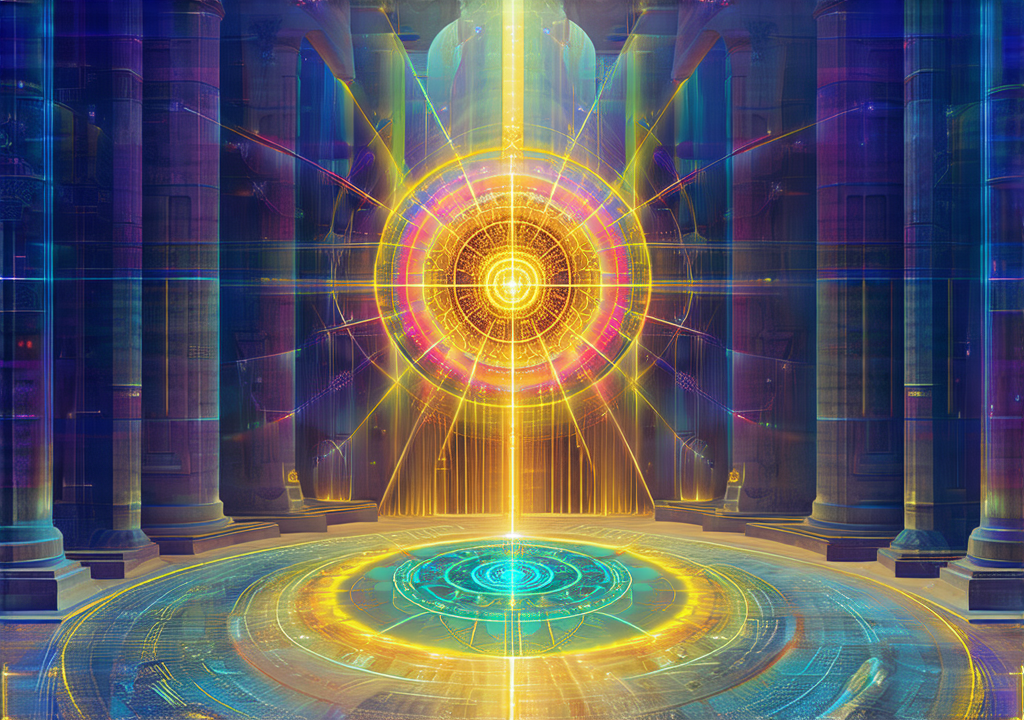
You’ve probably felt it—the subtle hum beneath everything you perceive as solid, real, permanent. That low-frequency vibration that tells you something is not quite what it appears to be. The “matrix” in question isn’t merely a metaphor borrowed from cinema; it’s the great illusion (the ma’asim of Kabbalah) that has wrapped human consciousness since before recorded memory began.
I’m writing this because I’ve been where you are—staring at what everyone else accepts as reality, sensing there’s more beneath it, and wondering whether the teachers speaking about hidden dimensions are truly seeing or merely reciting tradition. The difference between a Kabbalist and a mere student of Kabbalah is that one knows while another only believes.
Let me explain what I mean.
Kabbalah—the Hebrew word meaning “that which is received”—is not philosophy, not mysticism alone, but a living system for manipulating the fabric of perception itself. When you internalize its structures correctly, when you actually walk through them instead of merely studying their descriptions, you begin to see what others miss: the hidden layers beneath everyday reality.
The foundational text, the Zohar, describes three worlds—Atziluth, Beriah, and Yezirah—that overlap one another like transparent sheets stacked upon each other. Most people live entirely within their own layer, mistaking its limited vocabulary for the whole truth of existence. But those trained in Kabbalistic keys know how to step between worlds, how to pass through what appears as solid walls.
The Zohar says that “He who has a light and does not use it, shall lose his light.” This is precisely where most seekers fail—not from lack of knowledge but from failure to use the key they possess. Every true Kabbalistic text functions simultaneously as a map and an instruction manual: you can read about the Tree of Life in one year or actually climb it over seven years, each sephirah opening like a door only to those who know which names to invoke, which meditative states to inhabit, what precise combinations of sefirot correspond to different dimensions.
The real work begins when you understand that consciousness itself is the instrument of perception—and that Kabbalistic practice exists precisely to retrain it.
What follows next requires a shift in your own understanding of what you perceive as “real.” The Zohar teaches that there are forty-nine gates through which revelation enters human awareness, and each gate has its own name and signature. When you learn those names—which means learning them not intellectually but viscerally, until they resonate in your body like a tuning fork—you begin to notice the hidden worlds immediately.
The Tzimtzum—the divine contraction described by Isaac Luria—is what created space for creation, yet remains present within it. Everything is contained within the infinite even though we experience limitation. This paradox is the secret key: reality contains layers upon layers of meaning and substance, each accessible through specific practices and states of awareness.
I recommend beginning with the letter Aleph—not as a symbol but as an active force. The Hebrew letter has its own name, its own numerical value (1), its own vibration when spoken aloud in correct pronunciation. Kabbalists use it to trace specific frequencies that open corresponding gates in consciousness itself.
The path I offer is not about acquiring new information but awakening dormant structures within your own being. When you understand the true nature of these keys, they become more than concepts: they become living forces operating inside you and around you simultaneously. The distinction between “inside” and “outside”—between self and world—dissolves in Kabbalistic practice like sugar dissolving in water, not disappearing but becoming part of the whole.
This is why I write to you now, potential student: because you can feel there’s more waiting for you beyond what ordinary perception offers. The question becomes not whether the hidden worlds exist—they do—but whether you are willing to step through them and learn their names.


Recent Post



Gallery






Featured Videos







No Comments