


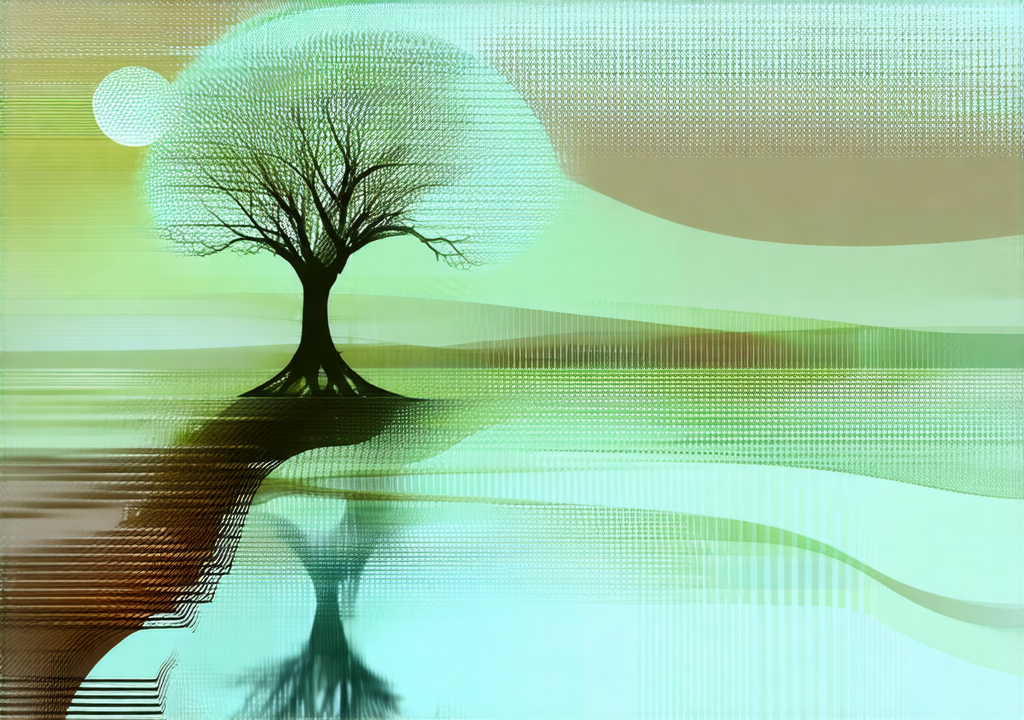
Kabbalah’s Answer to the Mystery
In every tradition, there exists a veil—a boundary that separates the seen from the unseen, the known from the unknown, the mundane from the divine. The ancient Hebrew word parochet describes this sacred curtain, woven with threads of understanding and layers of meaning. Behind it lies not just another room, but another reality altogether.
So what is truly behind the veil? Kabbalah’s answer may surprise you: something far more intimate than you might expect.
The Veil as Barrier—and Bridge
When we speak of the veiled world in Kabbalistic thought, we are not merely referring to a physical barrier or an invisible partition between dimensions. Rather, the veil is that subtle boundary where matter becomes spirit, where form dissolves into essence, where what appears ordinary begins to shimmer with hidden significance. The Zohar speaks of Sod—the secret—that which is concealed within and beside the manifest world, not separate from it but embedded within its fabric like seed-pods in fruit.
Kabbalists understand that behind the veil lies a whole world: a living, breathing universe of forces and energies that govern what we perceive as reality. These are not mere metaphors; they are genuine dimensions of being, just as real as any table or star, though invisible to ordinary sight. The Sefer Yetzirah, Book of Formation, teaches us that behind the veil lie thirty-one worlds: ten sefirotic realms arranged in a ladder ascending from earth toward heaven, connected by twenty-two paths and channels through which divine energy flows continuously.
The Ten Sefirot Behind the Veil
What most people recognize as Kabbalah’s heart is its system of ten sefirot—emissions or emanations of divine light descending from infinite source (Ein Sof) into finite creation. These are not abstract concepts but living forces: Keter (Crown), representing pure will; Chokhmah and Binah (Wisdom and Understanding); Tiferet (Beauty), the heart of the system; Netzach, Hod, Yesod—Victory, Glory, Foundation—leading to Malkuth (Kingdom), where divine presence becomes manifest in the physical world. Behind these ten lies their eternal source: infinite light, pure consciousness, unmanifest potentiality.
The Zohar calls this system Adam Kadmon, the Primordial Man—an archetypal being who contains within himself all worlds and energies. Behind the veil stands not a distant God but an intimate presence whose nature mirrors our own highest self. This is Kabbalah’s great revelation: behind the veil lies not only divine power but also your own soul, hidden from itself until you awaken to it through practice.
How Practitioners Piercing the Veil
The ancient Hebrew word for Kabbalah means “receiving”—that which comes downward toward us when we open ourselves. But Kabbalists knew well that receiving requires preparation and purification. The practitioner must become like a vessel: empty enough to receive, still enough to perceive, pure enough to hold what passes through.
Through meditation on divine names, visualization of the tree of life, and recitation of sacred words, practitioners gradually pierce the veil—not by force but by attunement. They learn to see not with ordinary eyes but with ayin, without—opening themselves to perceiving that which lies behind what appears before them.
The practice is called devekut (cleaving) and involves aligning one’s inner world with outer expression, so that whatever passes through the veil enters directly into consciousness rather than being filtered through ordinary perception. This state of cleaving becomes increasingly common among practitioners over years of dedicated work.
What Behind the Veil Is Actually You
Perhaps most remarkably, Kabbalah teaches that behind the veil lies not only divine light but also your own soul—your true self, which has been waiting patiently to be recognized. The Zohar calls this hidden essence tzelem Elohim, “the image of God”—not a metaphor about resemblance but rather the very substance from which you are formed.
When practitioners finally glimpse behind the veil, they discover that what lies beyond is not distant or strange but intimately familiar: their own being reflected back to them in divine light. The veil between the seen and unseen proves less like a wall than like a mirror—transparent when one looks through it, reflective only of superficial layers when viewed from below.
Conclusion
So what is really behind the veil? According to Kabbalah’s ancient wisdom: everything—and more importantly, yourself. Behind the curtain lies infinite light arranged in ten sefirotic forms; behind that lies your own soul waiting recognition; and behind that lies not God but rather you—the one who had been seeking all along.
This is Kabbalah’s great gift: it teaches us that we are not separate from what we seek but part of what we discover when the veil parts. The veiled world is our own hidden depths, the living reality beneath everyday appearances, waiting for us to awaken and see clearly.
What lies behind the veil? Simply put: yourself—and through you, all of creation’s secret beauty shining forth in light.


Recent Post

Gallery






Featured Videos




No Comments