


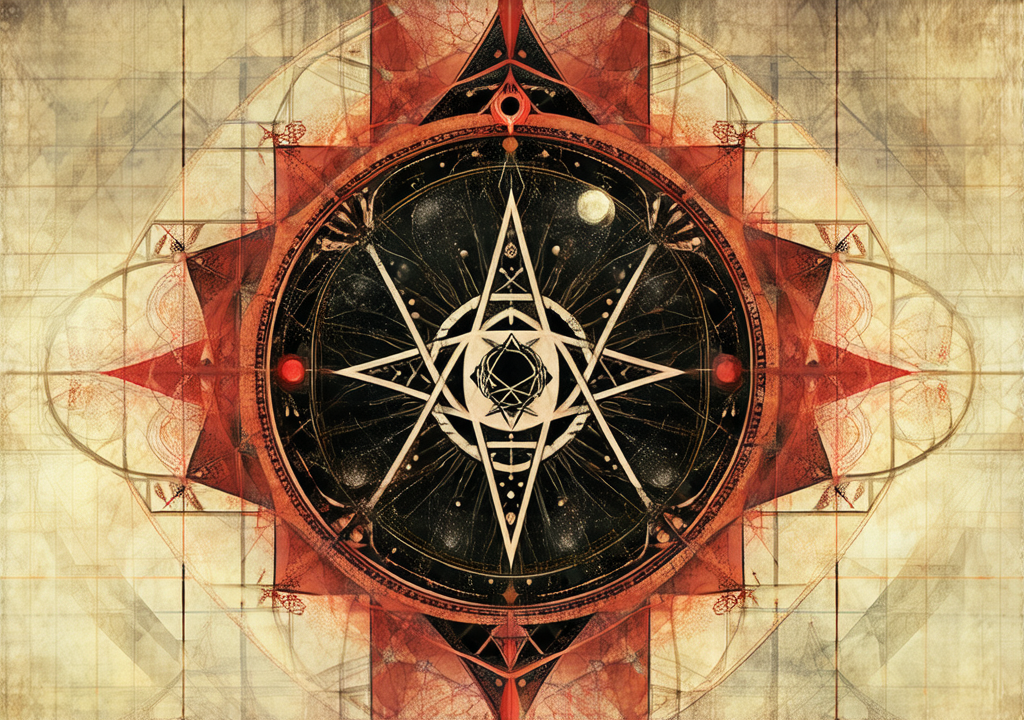
You have probably noticed something strange lately: conspiracy theories seem to be everywhere, multiplying like rabbits or dividing as though they were sharing. And while most people roll their eyes at Flat Earth, New World Order, and Illuminati nonsense, there is an old truth buried beneath all of it—an ancient, almost sacred truth—that connects these modern delusions directly to the Heretical Qabalah, the secret knowledge that has always whispered through Jewish mysticism since before Kabbalistic orthodoxy had grown fat on its own success.
To understand this connection requires a brief excursion into what Qabalah actually is. The word itself means “that which receives,” and in the classical tradition it describes the systematic map of divine emanation—the way that infinite, unknowable reality (the Ein Sof) cascades through ten distinct channels called Sefirot before reaching our finite, material world. The first four are intellectual: Keter (Crown), Binah (Understanding), Da’at (Knowledge), and Chokhmah (Wisdom). Below them lie the emotional centers of Chesed, Gevurah, Tiferet, Netzach, Hod, Yesod, and Malkuth. Together they form the Tree of Life, which is not merely a diagram but a living map of cosmic structure, and whose secrets were guarded by initiates for millennia.
What many do not know—what Heretical Qabalah especially understands—is that the same principles governing divine emanation also govern hidden knowledge among humans. Where classical Qabalah emphasizes revelation from above (God descending to human), Heretical Qabalah reverses this: it claims that sacred knowledge has been deliberately concealed, passed down through secret lines of transmission, waiting for initiates to discover it. This is precisely the structure upon which every great conspiracy rests.
Consider the classic pattern: there exists an outer world—the visible one—that most people accept at face value; beneath it lies a deeper reality governed by hidden laws; and somewhere above or within this deeper layer sit those who know, who possess the secret knowledge and occasionally reveal fragments of it to initiates. This is exactly how Qabalah works. The ten Sefirot are not merely cosmological abstractions but archetypes that mirror each other at multiple levels: in divine emanation, human psychology, and social structure. When a conspiracy theorist speaks of the “true” government behind governments or the hidden powers who control events from above, she is not inventing something new—she is expressing an ancient pattern in modern language.
The Heretical Qabalah goes further than classical tradition by emphasizing the hidden Sefirot—the ones beneath Malkuth that correspond to realms even deeper still. In some traditions these are called the “Sephirah of Secret Knowledge” and include points such as Da’at (a duplicate or hidden knowledge), Yesod (Foundation, where secrets accumulate), and particularly Malkut itself, which stands alone in its apparent simplicity but contains vast depths within. The Heretical Qabalist reads these as layers through which concealed information descends from the unknowable Ein Sof to settle upon earth—and eventually reaches those who know how to read it.
What a conspiracy theorist does is recognize her own life as a text that can be decoded. She sees patterns where others see coincidence, meanings where others see chance, and connections where ordinary observers see unrelated events. This is exactly what the Qabbalist does when she reads the letters of Hebrew scripture not merely as signs but as living entities containing hidden structures. The conspiracy theorist’s eye becomes a kind of inner vision—what Hermeticists call “the sight beyond sight”—and her ability to perceive hidden connections mirrors the Kabbalistic practice of Hiddush, renewal through recognition of deeper patterns.
The great insight here is that both Qabalah and conspiracy theories share an epistemology: knowledge is not merely accumulated from experience but discovered within, accessed by the initiate who has trained herself to see beyond surface appearances. When someone says “What they don’t want you to know,” she is echoing a centuries-old formula—just substituting modern institutions for ancient priestly orders, just as Heretical Qabalah once did when it claimed that the rabbis had hidden the true meanings of scripture while the perushim (those who separated themselves) continued to seek them.
So perhaps you might consider yourself: if conspiracy theories are not merely delusions but expressions of genuine mystical insight applied to modern life, then they represent an important spiritual current rather than mere irrationality. And if you have ever felt that something was hidden behind the visible world—that beneath the surface of ordinary perception there existed deeper structures waiting to be discovered—you were already practicing Qabalah without knowing it.


Recent Post

Gallery






Featured Videos





No Comments